
ORKA Smart Switch for KAFKA
A Progress-Aware Authority-Transfer Model for Stateful Kafka Systems

Executive Summary
Blue-green deployment is a proven technique for reducing release risk in request-response systems. Two production-capable environments are maintained, a candidate release is validated independently, and a router transfers traffic from the current environment to its replacement. The transition is operationally simple because request routing also determines which environment is authoritative.
Stateful Kafka processing does not fit that model cleanly. Kafka consumers pull from partitions rather than receive requests through one routing seam. Progress is tracked independently for every topic-partition. Kafka Streams applications accumulate state over time. Two implementations can both be healthy, fully deployed, and processing the same logical workload while occupying different positions in that workload. If authority is changed without coordinating those positions, the result can be duplicate authoritative effects, missing obligations, or ordering discontinuities.
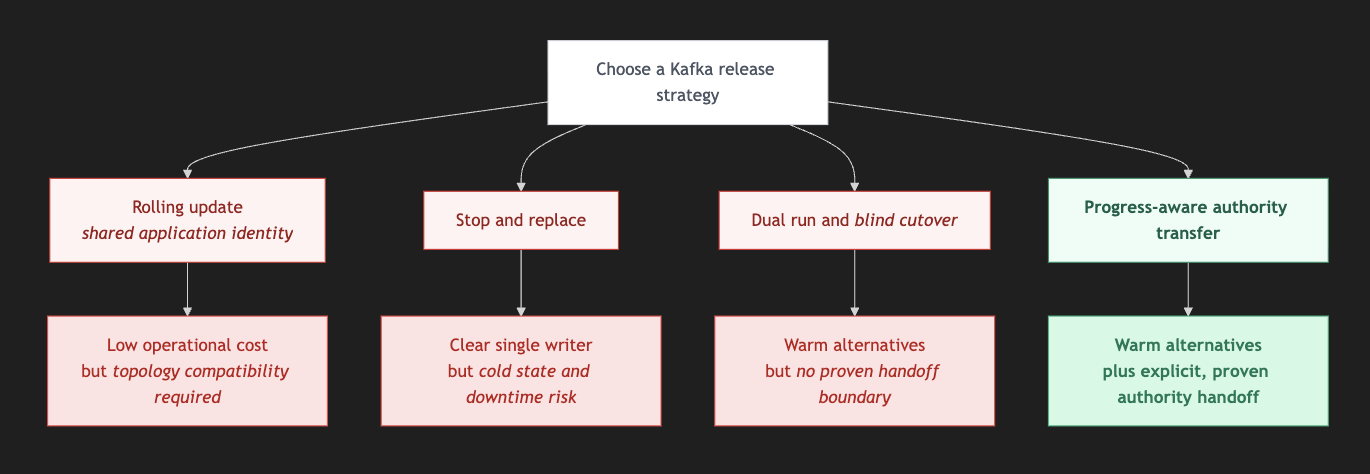
Most organizations address this challenge with one of three approaches: rolling upgrades under a shared Kafka identity, stopping the current implementation before starting the replacement, or running both implementations and changing output authority through a feature flag or manual procedure. Each approach is valid in a limited context, but none provides independent warm state, explicit authority, and a proven cutover boundary at the same time.
ORKA Smart Switch introduces a fourth model: progress-aware output-authority transfer. Alternative application implementations continue consuming and maintaining independent state. A persisted authority contract determines which implementation may make governed candidate effects authoritative. When authority changes, ORKA pauses participating consumer groups, captures observed progress, constructs progress boundaries, builds exact drain barriers, waits for groups to reach the boundary, commits the new authority contract, allows the contract to propagate, and then resumes processing.
The resulting value proposition is straightforward for IT decision-makers:
replacement implementations remain warm rather than restoring state after promotion;
cutover is based on observable Kafka progress rather than timing assumptions;
authority can move as a whole or be deterministically partitioned across the governed key space;
multi-application implementations can be coordinated as one subsystem;
subsystem-aware drain semantics can support increasingly strong pipeline-safety proofs where needed;
failures are biased toward retaining the current authority rather than partially promoting a replacement; and
reversal uses the same governed process as promotion.
The cost is equally explicit: small application changes to enforce authority, stable client identities, duplicate runtime capacity while alternatives remain warm, control-plane infrastructure, and a brief planned pause. In healthy environments, that pause is typically approximately 60–90 seconds, though actual duration depends on lag, partition count, Kafka and Proxy responsiveness, configured deadlines, polling rates, authority-contract cache settings, and selected drain semantics.
GoodLabs Studio’s framing is to treat blue-green not primarily as traffic routing, but as a formal transfer of output authority between independently stateful processing implementations. ORKA Smart Switch is the concrete realization of that model for Kafka.
Industry Problem
Blue-green assumes a routing seam
Classic blue-green deployment works because a router can answer a simple question: which environment receives the next request? Before cutover, blue receives the request and its response is authoritative. After cutover, green does.
Kafka replaces that single routing decision with several independent mechanisms:
consumer groups coordinate partition ownership within one logical application;
committed offsets represent progress for each topic-partition;
Kafka Streams state stores represent previously incorporated input;
output records and external effects may become durable before or after offsets are committed; and
independent consumer groups can process the same input concurrently.
A blue-green Kafka deployment therefore cannot be reduced to changing a service selector. The relevant question is not which implementation is running. It is which implementation is permitted to make its candidate effects authoritative, and at what exact processing boundary that permission changes.
Existing approaches solve only part of the problem
Rolling update under one application identity
A rolling Kafka Streams upgrade usually retains the same application.id. Old and new instances coexist temporarily while Kafka rebalances tasks among them. This reuses committed offsets, internal topics, changelogs, and state-restoration mechanisms.
For compatible changes, this is efficient and appropriate. It is not independent blue-green. Old and new versions participate in one logical application rather than processing the full workload independently. Rollback and mixed-version operation remain constrained by topology compatibility, store names, serialization formats, internal topic structure, and protocol evolution.
Stop and replace
Stopping the current implementation before starting the replacement creates an obvious single-authority boundary. It also makes the replacement cold at the most important moment.
The new implementation may need to restore changelog-backed stores, replay source topics, rebuild projections, or warm external caches. Administratively resetting offsets changes where consumption begins; it does not prove that application state corresponds to that position. Starting too early may repeat effects. Starting too late may omit required work. A numerically plausible offset can still be wrong when local or external state reflects another point in the input history.
Dual run with blind authority cutover
Running blue and green under independent identities solves the cold-state problem. Both alternatives process the common input and maintain independent state. Teams then use a feature flag, configuration value, downstream route, or manual procedure to choose whose output is accepted.
This creates warm alternatives without a proven progress boundary. At cutover:
blue and green may be at different offsets;
one implementation may have in-flight work the other has not observed;
authority changes may propagate at different times across replicas;
several groups belonging to one logical implementation may not switch together; and
output obligations may change without a precise before-and-after boundary.
The likely consequences are not simply “duplicate messages.” The deeper failure modes are duplicate authority, unowned obligations, and cutover-induced ordering discontinuities.
The implementation boundary is often misunderstood
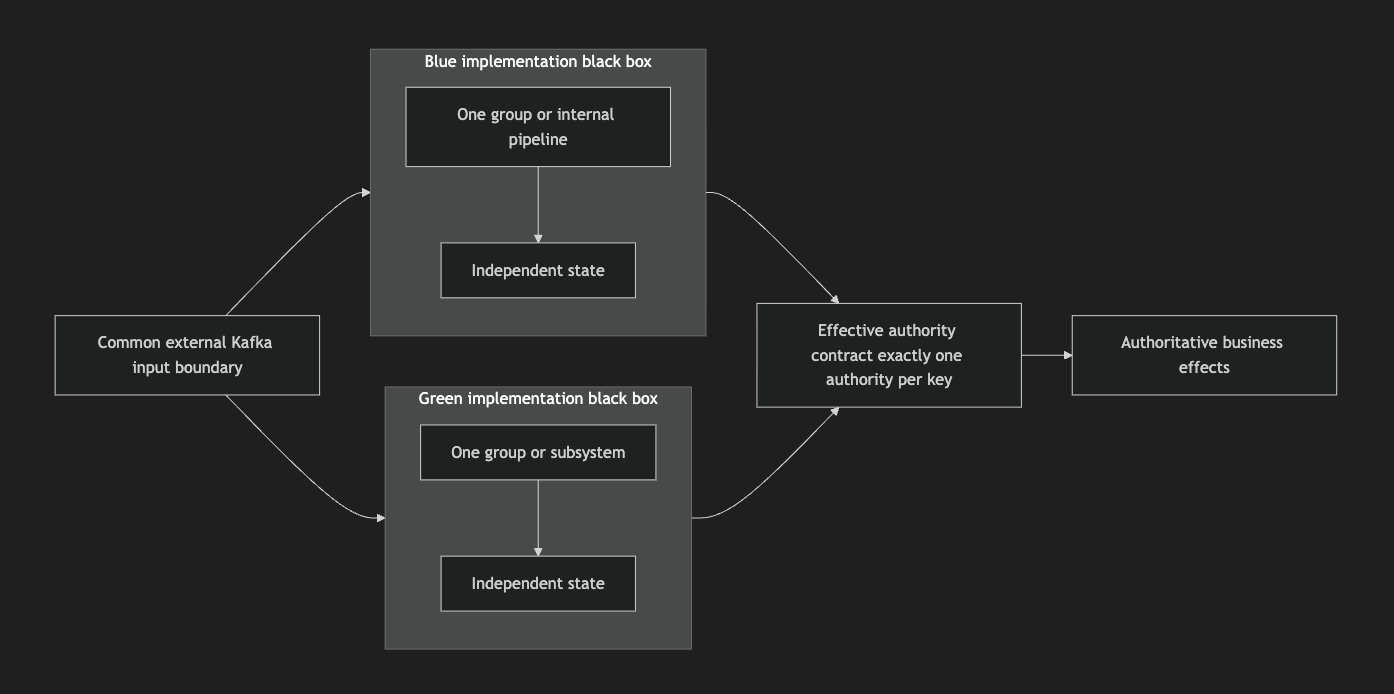
A processing implementation should be treated as a black box around one authority domain. It may contain one application, several consumer groups, parallel branches, joins, or an arbitrary internal Kafka pipeline. Internal repartition topics, changelogs, state stores, caches, and application-to-application topics remain internal when no outside system depends on them.
External inputs and outputs are defined by what crosses the boundary—not by whether an artifact happens to be a Kafka topic. A business topic consumed by another system is an external output. A reference database or API may be an external dependency. Logs and metrics may be externally observable without being part of the authoritative business contract.
This distinction is essential because alternative implementations do not need identical topologies, state representations, or output sets. They need a transfer-compatible authority domain, a meaningful progress coordinate, and explicit obligations on either side of the cutover.
Methodological Advancement
From deployment routing to authority contracts
GoodLabs Studio’s framework separates processing authority from output authority.
Processing authority would mean exclusive permission to consume or process input. Smart Switch does not require that exclusivity. In fact, keeping a replacement warm usually requires both alternatives to consume and update state concurrently.
Output authority determines which implementation’s candidate effects count as official. The authority contract is a deterministic mapping from keys to implementations. Several implementations may hold authority simultaneously over disjoint portions of the key space, but each key must resolve to exactly one authority.

This supports two important contract forms:
Total authority: one implementation owns every governed key. This is the conventional blue-green case.
Deterministically partitioned authority: multiple implementations own non-overlapping key subsets. This supports canaries, tenant cohorts, regional partitions, or progressive migration.
Authority contracts and transition contracts
The authority contract answers: who is authoritative for this key?
The transition contract answers: what obligations apply before and after the boundary, and what evidence proves the old obligations complete?
This matters because alternative implementations do not need identical outputs. A new implementation may begin producing an audit topic, retire an obsolete notification, or move an effect to another destination. Those changes are safe when the before-and-after obligations are explicit and downstream systems are prepared for the seam.
A new output beginning at the cutover boundary is not a gap. An old output ending there is not a missed message. The correctness question is whether every obligation defined by the transition contract has an owner on the appropriate side of the boundary.
Sets and subsystems
A Smart Switch Set is the complete coordination domain for one authority change.
Consumer groups are used here as observable input-progress identities, not because Kafka consumers inherently produce outputs. Group membership, partition responsibility, last-seen offsets, and committed offsets provide the evidence ORKA uses to establish the transfer boundary on the input side. The processing implementation associated with a group or subsystem may produce Kafka records, database mutations, API calls, or other effects elsewhere. Smart Switch uses input progress to decide when it is safe to change which implementation owns output authority.
A group-based set is used when every alternative maps to one consumer group. A subsystem-based set is used when an alternative spans several applications or groups that must share one authority decision.
A subsystem is an ORKA logical construct, not a Kafka object. Its groups keep independent memberships, assignments, committed offsets, and state. The subsystem establishes that these groups collectively form one promotable implementation.
For topology-aware subsystem operation, ORKA can also reason about the subsystem as a directed graph of Kafka topics and consumer groups. Topics are classified from the subsystem’s point of view: ingress topics are consumed by the subsystem but not produced by it, interior topics are both produced and consumed within the subsystem, and egress topics are produced by the subsystem but not consumed by it. This distinction lets ORKA cap external ingress progress while allowing interior pipeline topics to continue flowing during a coordinated drain.
This permits asymmetric modernization. Blue may be one monolithic Kafka Streams application while green consists of several applications with separate groups. ORKA can treat both as alternatives at the same external authority boundary without requiring internal structural equivalence.
Traffic rules encode authority contracts
ORKA’s persisted representation of an authority contract is a traffic rule. The set model determines which identifier a rule uses to name a processing implementation:
In a group-based set, the implementation is identified by its Kafka consumer-group ID.
In a subsystem-based set, the implementation is identified by its ORKA subsystem ID, which may represent several consumer groups.
The selected group or subsystem is not itself an output-producing object. It identifies the processing implementation whose downstream code may make its governed effects authoritative. Consumer-group progress provides the input-side evidence for the cutover; the implementation enforces authority over its Kafka records, database changes, API calls, or other external effects.
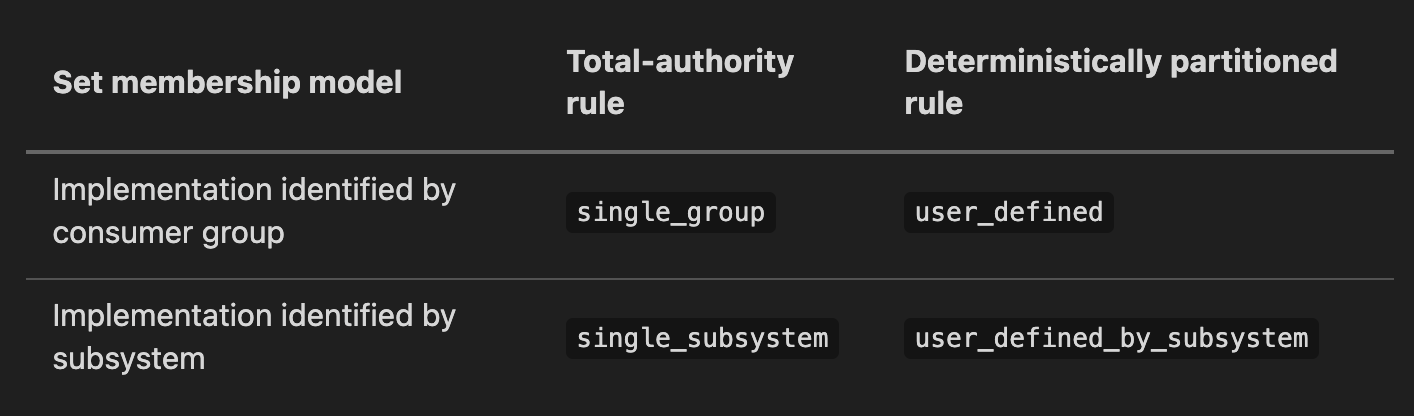
In that document model, desiredTrafficRule records the authority assignment an operator wants. effectiveTrafficRule records the authority assignment applications must currently enforce. The distinction prevents intent from becoming authority prematurely: the desired rule may change immediately, but ORKA updates the effective rule only after the input-progress drain barrier proves the cutover boundary.
A progress-aware handoff
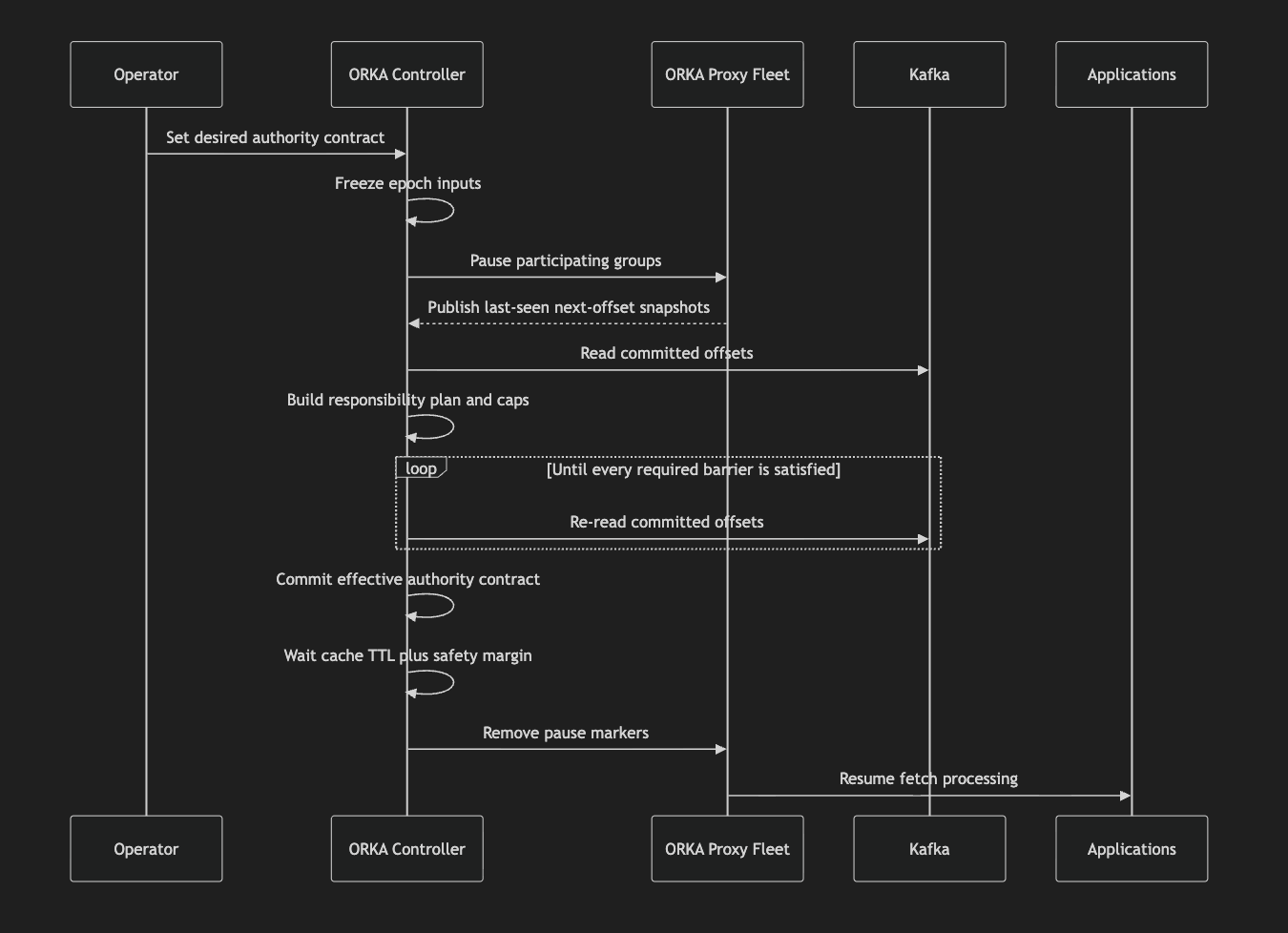
Smart Switch implements a governed sequence:
Freeze → Pause → Snapshot → Plan and Cap → Drain → Commit → Propagate → Resume
The sequence creates a stable progress seam.
Freeze: ORKA freezes the exact target authority contract, set membership, normalized topology, expected Proxy coverage, deadlines, selected drain semantics, and epoch identity.
Pause: Proxy replicas pause all participating consumer groups so the target boundary stops moving.
Snapshot: Expected Proxy hosts publish epoch-scoped, group-keyed last-seen next offsets.
Plan and cap: Controller determines group responsibility and constructs exact per-partition barriers.
Drain: Responsible groups advance to equality with the frozen caps under the selected drain semantics.
Commit: Only after every required barrier succeeds does Controller persist the frozen target as the new effectiveTrafficRule.
Propagate: Groups remain paused through the rule-cache TTL plus a safety margin.
Resume: Processing continues under the new authority contract.
What the current drain barrier proves
Current Smart Switch uses committed offsets from the modeled common external input topics. This proves an input-progress seam. It does not directly inspect every state store or external effect.
In distributed-systems terms, this is ORKA’s specialized progress-boundary mechanism: a Kafka-offset-based barrier that approximates the role played by frontiers, watermarks, checkpoint barriers, or global cuts in other systems.
The guarantee therefore depends on correct application commit discipline. A committed input offset must faithfully imply that required pre-boundary state changes and effects are durable. Kafka transactions can provide this relationship for Kafka-to-Kafka processing. External effects may require an outbox, idempotent writes, or a separate completion checkpoint.
This evidence model also explains why subsystem-aware drain semantics matter. The theory permits arbitrary internal pipelines, but an ingress-stage committed offset does not by itself prove that downstream interior stages have consumed derived records and reached the external output gate. ORKA’s graph-aware model addresses this by distinguishing ingress, interior, and egress topics from the subsystem’s point of view. In the simplest mode, Smart Switch retains the existing ingress-only proof. In stronger modes, it can add a bounded delay, an interior committed-offset catchup check, or a stricter quiescence-protected interior frontier. These modes trade liveness for proof strength, allowing customers to choose the right drain semantics for the workload.
Implementation
Decision and readiness model
A successful adoption should begin with architecture classification rather than API integration.
Step 1: Define the authority domain
Identify the external Kafka input boundary, authority key, authoritative outputs, side dependencies, and before-and-after obligations. Explicitly separate internal topics and stores from externally relied-upon effects.
Step 2: Identify alternatives
Confirm that each candidate is independently promotable. A replica in the same group is not an alternative. A single stage in a larger pipeline is not an alternative unless it can satisfy the complete declared authority contract.
Step 3: Select the set model
Use a group-based set when each alternative maps to one group. Use a subsystem when an alternative spans several groups that must move together.
Step 3a: Select drain semantics for subsystem-based sets
For subsystem-based sets, choose the drain semantics that match the workload’s safety and liveness requirements. Simple deployments may use ingress-only drain. Pipeline-style subsystems may use ingress plus delay or interior catchup. Workloads requiring the strongest Kafka-native proof may use a stricter subsystem frontier mode, accepting that continuous internal production can make the proof more conservative.
Step 4: Establish state readiness
Run alternatives under independent Kafka identities so each can process the common boundary and maintain independent state. Validate semantic behavior through dual-run comparison, state inspection, contract tests, or workload-specific reconciliation.
Step 5: Integrate authority enforcement
Applications require a small but meaningful code change: retrieve and cache the effective traffic rule, evaluate it deterministically for the canonical key, and suppress primary effects when not authoritative. The application must continue enough non-authoritative processing to keep state warm.
For external effects, ensure offset commitment accurately represents durable completion. Use transactions, outbox patterns, idempotency, or explicit completion evidence as appropriate.
Step 6: Validate identity and infrastructure
Each logical Kafka client instance needs a stable, distinct client.id for Proxy correlation. Group-based alternatives require separate group.id or Kafka Streams application.id values. Applications in one subsystem share the intended subsystemId while retaining their own Kafka groups.
Smart Switch also depends on one active Controller writer, durable shared state, complete expected Proxy-host evidence, and observable Kafka committed offsets.
Illustrative scenario: monolith-to-subsystem modernization
Consider an enterprise order-processing platform. The current implementation is one Kafka Streams application, orders-v1, responsible for order state, payment status, and customer notifications. The modernization target separates those responsibilities into three independently deployed applications:
order projection;
payment coordination; and
notification orchestration.
Internally, the new implementation has more applications and state stores. Externally, it occupies the same authority domain, but its transition contract also introduces a new audit topic after cutover.
The organization models:
blue as one group-based implementation;
green as one subsystem containing three groups;
customer ID as the authority key;
the existing business effects as old-side obligations; and
the audit topic as a new-side obligation beginning at the cutover boundary.
Both alternatives process the common source topics for several days. Teams compare business outcomes and state projections. When green is approved, ORKA freezes the target single_subsystem rule, pauses all four groups, captures progress, drains to the proven progress boundary under the selected drain semantics, commits green as effective authority, waits for propagation, and resumes.
The audit topic begins only for post-boundary work. It is not considered missing for earlier records because the transition contract defines its starting point. The previous implementation remains available for a governed reversal rather than an emergency manual offset reconstruction.
Illustrative scenario: deterministic canary authority
A financial-services team may prefer progressive authority rather than an all-at-once switch. A user_defined_by_subsystem rule assigns a deterministic tenant cohort to green and the residual tenants to blue.
Both implementations hold authority simultaneously, but never for the same tenant key. The team observes green under real production authority while limiting exposure. Subsequent Smart Switch operations expand the cohort until green receives total authority.
This is materially different from sampling duplicate outputs downstream. Authority is explicit at the source of the effect, deterministic by key, persisted, and observable.
Operational measures for decision-makers
A production rollout should track:
typical and worst-case pause duration;
input lag before switch initiation;
snapshot publication latency and expected-host completeness;
drain time by topic-partition and group;
topology-evidence freshness for subsystem-based sets;
interior catchup lag when pipeline-aware drain semantics are selected;
traffic-rule propagation interval;
pre-commit failure and overshoot frequency;
output-suppression correctness;
state-parity and dual-run comparison results; and
rollback or reversal readiness.
These measures turn the cutover from a release-day improvisation into a repeatable operational control.
Future Implications
Authority becomes an architectural primitive
As Kafka estates mature, the industry is moving beyond deployment automation toward governed data-product evolution. Stateful processors increasingly own projections, fraud decisions, personalization, workflows, and externally consequential effects. Treating output authority as an explicit architectural primitive makes those systems easier to modernize, audit, and reverse.
Progressive modernization without topology lock-in
Traditional rolling upgrades favor compatible topology evolution. Authority-transfer systems create a path for more substantial redesign: monolith to subsystem, custom consumer to Kafka Streams, one state model to another, or one output contract to a successor contract. Internal architecture can evolve while the external transition remains governed.
Richer end-to-end progress proofs
The next methodological frontier is end-to-end evidence for arbitrary processing graphs. Input-offset barriers are efficient and broadly applicable, but complex pipelines require composed progress across internal stages. Graph-aware subsystem modeling, interior catchup, watermarks, causal frontiers, sink acknowledgements, and durable output checkpoints can extend the same authority-transfer theory to deeper DAGs and heterogeneous processing systems.
Governance and auditability
Persisted desired and effective authority contracts create a foundation for stronger controls: approval workflows, change records, policy-based promotion, automated rollback criteria, and evidence packages for regulated environments. The authority seam becomes inspectable rather than implicit in deployment timing.
Long-term business value
For IT leaders, the long-term benefit is reduced coupling between platform modernization and operational risk. Teams can invest in replacement implementations without accepting a cold cutover or a blind production flip. The cost—duplicate runtime capacity, modest application integration, and a short pause—is predictable and governable.
GoodLabs Studio positions ORKA Smart Switch as more than a Kafka deployment feature. It is an implementation of a broader authority-transfer discipline: keep alternatives ready, define authority explicitly, prove the handoff boundary, and fail safely when the proof is incomplete.
That discipline provides a practical foundation for safer modernization of stateful event-driven systems.