

Scaling an International FSI's Engineering Capacity to Deliver Real-Time Systems for 100,000+ Employees
With Polyagentic Autonomous Microservice Factory.

Step 1:
Asymmetry Audit
We partnered with the engineering team to identify where AI could deliver the greatest leverage. Rather than targeting simple applications, we selected event-driven streaming microservices because they are among the most complex systems to design, implement, test, and debug. Their complexity and lengthy development cycles made them the ideal production case to demonstrate how Polyagentic AI can dramatically accelerate enterprise software engineering.
The opportunity: enable developers to deliver complex real-time systems 10× faster while maintaining enterprise-grade quality and reliability.
Step 2:
Architecture Fit
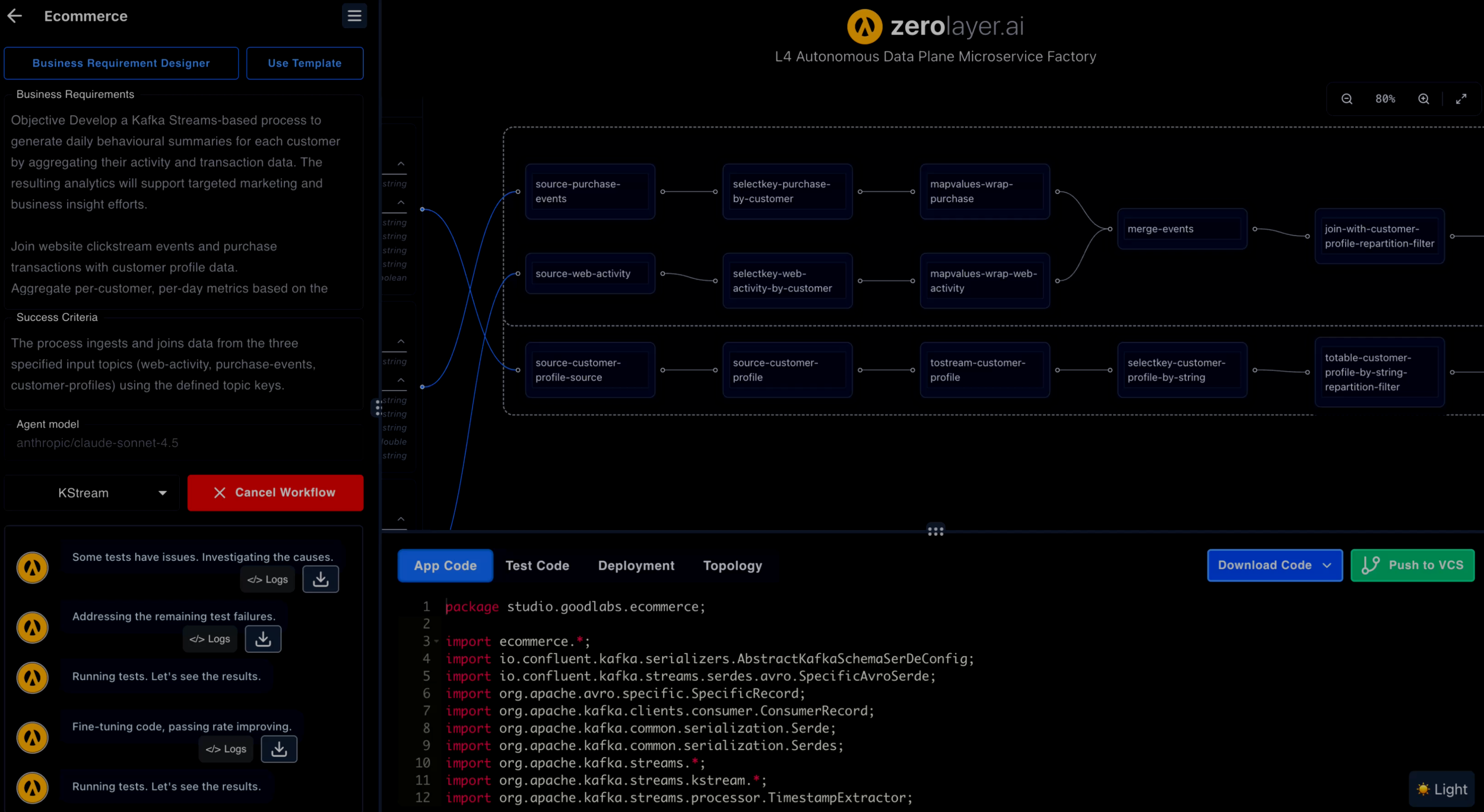
We designed the solution around the FSI's existing Confluent Data Streaming Platform (DSP) by extending ZeroLayer, our autonomous microservice factory, to integrate directly with its event-driven architecture. From business requirements, ZeroLayer autonomously generates streaming application code, unit tests, and deployable packages, leveraging Confluent DSP for real-time processing of mainframe data. The output integrates seamlessly into the organization's existing CI/CD pipeline, enabling production-ready streaming microservices with minimal developer effort.
The outcome: an AI-native software factory that transforms business requirements into production-ready, real-time applications integrated directly into the enterprise delivery pipeline.


Step 3:
Instrumented Pilot
We embedded directly with the FSI's engineering team to validate ZeroLayer against real production development practices. Working closely with their developers, we captured the complexities of streaming application engineering, including joins, aggregations, windowing, and state management, while ensuring the generated code adhered to the organization's coding standards and architectural patterns. Each iteration was measured for functional correctness, deployment readiness, and developer feedback to continuously improve the autonomous development pipeline.
The outcome: ZeroLayer autonomously generated production-ready streaming microservices aligned with the FSI's engineering standards, establishing a trusted foundation for enterprise-scale adoption.d foundation for broader enterprise adoption.
Step 4:
Expertise Extraction
We established a human-within-the-loop feedback process across business requirements, test coverage, code generation, and deployment validation. Every review, correction, and engineering decision was systematically captured to continuously enrich ZeroLayer's expertise repository, allowing it to learn the FSI's engineering standards, development practices, and evolving architectural direction. As expertise compounds over time, ZeroLayer continuously adapts and becomes increasingly autonomous while remaining aligned with the organization's engineering principles.
The outcome: Human expertise was transformed into a compounding enterprise asset, enabling ZeroLayer to continuously improve and generate organization-specific software with increasing accuracy and autonomy.

Step 5:
AI Compression & Funneling
Rather than relying on the largest frontier models, we engineered ZeroLayer to maximize performance and efficiency. Using Anthropic Claude Sonnet 4.5 as the base coding model, we continuously refined prompts, data plane expertise, and polyagent interactions through a sidecar learning approach to minimize context drift and maximize code correctness. Our research team also continuously evaluates distilled open-weight models to further reduce cost while improving autonomous software delivery.
The outcome: Production-grade autonomous software delivery at significantly lower cost through a continuously improving AI stack.
Step 6:
Govern and scale
We established a governance framework that continuously measures cost, development time, and successful deployment for every autonomous microservice. These metrics drive ongoing optimization of ZeroLayer while providing clear ROI and quality benchmarks. As confidence grows, the platform is systematically expanded to additional microservice domains, enabling the FSI to scale autonomous software engineering while maintaining engineering quality and business alignment.
The outcome: A governed, measurable path to enterprise-wide autonomous software development with continuous improvements in delivery speed, cost efficiency, and engineering quality.

SPEAK TO OUR POLYAGENTIC AI ARCHITECTS
Discover how GoodLabs Polyagentic AI Engineering helps you identify the biggest asymmetries, scale human expertise, earn autonomy, and turn each successful implementation into a blueprint for enterprise-wide impact.